
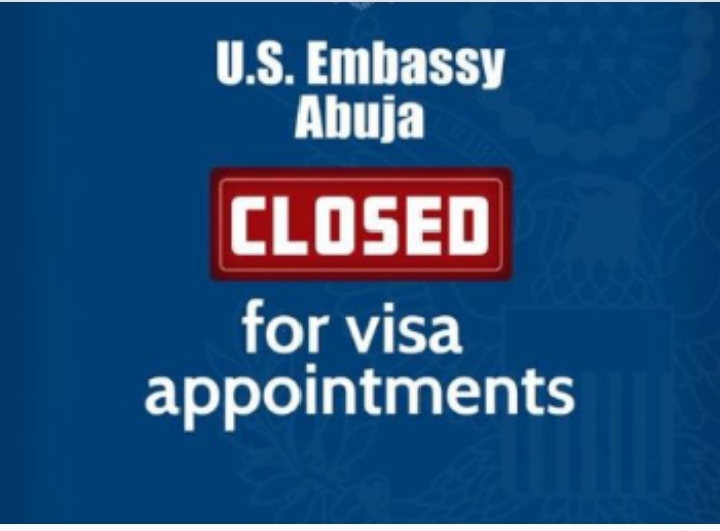
The United States Mission in Nigeria has announced the suspension of visa appointments at its embassy in Abuja.
The announcement was made via the mission’s official X (formerly Twitter) account on Thursday. According to the statement, applicants affected by the suspension are advised to check their email for updates regarding rescheduled appointments.
“U.S. Embassy Abuja is closed for visa appointments. Applicants should check their email for details on rescheduled appointments,” the statement read.
However, the mission clarified that visa services remain fully operational at the U.S. Consulate General Lagos.
It also noted that services for American citizens are still available in emergency situations and by appointment.
This development follows a broader security advisory issued by the United States Department of State, which recently authorised the departure of non-emergency staff from its Abuja embassy. The advisory also expanded its “Do Not Travel” list in Nigeria to include 23 states.
While Nigeria remains under a Level 3 advisory—“Reconsider Travel”—the State Department warned of heightened risks in certain areas due to crime, terrorism, civil unrest, kidnapping, and limited access to quality healthcare.
The advisory highlighted that U.S. citizens are often targets for kidnapping and robbery, while terrorist threats persist in public spaces such as markets, religious centres, hotels, and large gatherings.
Concerns were also raised about the state of healthcare services, noting that hospitals frequently require upfront cash payments, ambulance services are unreliable, and blood supply systems are inconsistent. In serious cases, medical evacuation may be necessary.
U.S. citizens in Nigeria were advised to enrol in the Smart Traveller Enrollment Programme (STEP), avoid large gatherings, vary daily routines, and maintain emergency evacuation plans independent of government assistance. The advisory also recommended establishing “proof of life” protocols with family members in case of kidnapping.
The updated “Do Not Travel” list includes states such as Borno, Kogi, Yobe, and parts of Adamawa due to terrorism and kidnapping risks. Other states—including Bauchi, Gombe, Kaduna, Kano, Katsina, Sokoto, and Zamfara—were flagged for banditry and communal violence.
In the South-East and Niger Delta regions, states like Abia, Anambra, Bayelsa, Delta, Enugu, Imo, and Rivers (excluding Port Harcourt) were cited for crime, unrest, and kidnapping.
Additionally, Plateau, Jigawa, Kwara, Niger, and Taraba were newly added to the highest-risk category, reflecting the spread of insecurity, particularly in the Middle Belt where farmer-herder conflicts continue to escalate.
The advisory described the situation in these areas as volatile and unpredictable, warning that security operations may occur without prior notice.